[Interview with Management] Why CTO Korezawa is a "modern-day Yoshida Shoin" and is supporting the next generation of "transformation"

"Innovation" creates new products, services, business models, and markets. Innovation (= transformation) is essential for corporate growth and industrial development.
So what are the elements necessary for a company to bring about change? And what kind of self-transformation is required of individuals working in such an organization? This series will focus on the theme of "change" and will share the thoughts of four members of XICA's management team.
"I want to hand over my position to the younger generation and get fired," says Futoshi Korezawa, who is involved in organizational reform within the company as CTO of XICA. As he cultivates the soil of XICA and tries to create an environment where the next generation can easily bring about change, how does he view "change" in organizations and individuals?

CTO, XICA
Futoshi Koresawa
Since starting his career as an IT engineer in 2000, he has served as tech lead, CTO, and VPoE at 12 companies, including Tose Corporation, CA Mobile Corporation, ALBERT Corporation, Speee Corporation, and Mercari Corporation. He joined XICA in January 2020 and was appointed CTO at the same time. He also serves as CEO of Cross Garage LLC, and as an advisor on technology, organization, and products for multiple companies.
The moment I realized I was going to be fired

- Mr. Koresawa, you have worked as an IT engineer and technical advisor for many companies, but what first sparked your interest in IT engineering?
I originally wanted to be a game creator, so I taught myself programming from junior high school. From the age of 18 to 20, I went to a game-related vocational school in Tokyo and delivered newspapers in the morning and evening as a newspaper scholarship student while attending school.
However, I finished the textbooks handed out at school in six months by self-study, and the specs of the PC I built myself were better than the school's, so partway through I didn't feel the need to go to school anymore (laughs).So I got an internet connection into the newspaper company dormitory, and while delivering newspapers, I published websites on the internet and ran a chat site, repeating the process of self-study input and output.
After that, I didn't go to school properly, so I couldn't find a job and was deported back to my hometown, Ehime (laughs). Then, one day, I was introduced to someone who was starting an IT venture in Ehime, and I joined as an engineer. While working there, I started to find IT engineering interesting. In 2000, it was a time when IT was just starting to take off.
After about two years, I moved back to Tokyo and moved around to various companies, including subsidiaries of a game manufacturer and business companies, gaining experience in a wide range of product development, including games, media, ad delivery engines, and search engines.
-So, when did your role shift from field work to managing the organization?
I started managing teams in my late 20s, but I didn't get serious about it until I turned 30. Around that time, I started reading more and more books about management and marketing, such as those by Drucker and Kotler.
After joining Speee and being given the role of management manager, I began to focus even more on my role of "management."
After working there for about three years, Speee began to be recognized by people outside the company as a company that focuses on technology, and as a result, I gradually began to receive inquiries from other companies for roles such as advisory.

- You started out as an external advisor to XICA. What made you decide to officially join as CTO?
Yes, that's right. At that time,I want to create a system for developing autonomous organizations, teams, and people.I had this feeling, and I thought I could achieve this together with the management team at XICA.
That's because I was able to gain a global perspective thanks to working with CTO Namura and his team at Mercari, where I worked just before joining XICA. As I learned about overseas cases and organizations, I realized that repeatedly conducting proof-of-concept tests of what I had learned at small companies suited my personality.
The scale of XICA was the perfect environment for me to fulfill my role.By helping to build an organization that can multiply profits and make many people happy, you can accumulate virtue yourself.I felt that.
More than anything"Talent blossoming" I was struck by the words. I have great respect for Yoshida Shoin, and I think these words are very close to his way of thinking.
Although Shoin himself did not leave a big mark, he was a person who raised great men who transformed Japan, such as Takasugi Shinsaku and Ito Hirofumi, at his private school, Shoka Sonjuku.Is it possible to live a life like Shoin's, entrusting our hopes to the next generation? I thought so (lol).
At XICA, we train "people who will change the times" and then after about three years, we hand over our positions to someone else."Fire yourself."I use the expression "I want to work hard," and it was with these thoughts in mind that I decided to join the company.
If we can encourage and empower the younger generation, the world will become a more interesting place.

- "Fire yourself" is a very powerful phrase.
It's not necessarily a negative thing, but a positive thing (laughs). Once an organization has stabilized to a certain extent, changing the top management will bring about a new era, and I think that's healthier.Once we have achieved success in "developing an organization," let's hand it over to the next generation.,When.
I think I started to be conscious of this after I started reading Drucker. At first, I was worried that changing roles in a short period of time would give a negative impression, but as long as you have results and achievements, I felt that society actually needs people like that.
Because I realized thatLet's fire ourselves, pass the baton to the next generation, and grow even more by challenging ourselves in new areas.I have come to think and act in this way.
-What specific actions does it mean to pass on the knowledge to the next generation?
I think there are broadly two ways to go about this.
One isHow to build a foundation and pass it on to the next generationAnd the other one isHow to drive a wedge and then walk away.
For example, when making fundamental changes to an organization with a long history and proven track record, the latter approach may be unavoidable.
When trying to bring about change in an organization where most people dislike change and halation, unless someone presents an idea and shows the will to change the conventional way of doing things, there will be no sign of change.I have to do it even if it means sacrificing myself" You need to be prepared to say, "I will do my best to help you." I think that even Shoin was able to change the world because he was prepared to face criticism and stuck to his beliefs. In that sense, I think that when I pass the baton to the next generation, if I make up my own mind and take risks, it can help the next generation to blossom.
-Where does the motivation to "support the next generation" even at the cost of sacrificing yourself come from?
"I want to make the world more interesting through manufacturing."That's the way I think about it. As information and technology are updated with the times, I think that the younger generation, who are familiar with the latest education and new gadgets, tend to have more advanced abilities suited to the times.
So, to bring out the potential of the younger generation and make them flourish...If their potential could be freed up, wouldn't the world be a more interesting place?I think.
And if we can create a world where money naturally flows to the younger generation as their talents blossom and they pursue what they love, with people thinking, "If we support this person, something interesting could happen," then I think the possibilities will expand and the world will be a more interesting place.
I believe that businesses with ideas so interesting that they make people think, "It would be amazing if we could make that happen!" can be the catalyst for creating new innovation, so I want to actively support such challenges.
For example, Hirao's goal of "bringing out all the talents in the world" is so big that it's no wonder he's seen as a braggart. But it's interesting because he's trying to tackle it seriously, and it makes me want to support him with all my might.
Create an environment where changemakers can move freely

-What kind of changes has Mr. Koresawa actually implemented at XICA?
When I first joined as CTO,A development organization that operates with a manufacturing worldviewWe wanted to create an ideal development organization, so we created our own unique systems for doing so, including introducing an evaluation system unique to the development organization and organizing a human resources department (DevHR) that is specialized within the development organization rather than a corporate organization.
Normally, when a special organization is restructured in this way to optimize things locally, it would be viewed negatively by other departments, but Mr. Hirao respected my ideas and supported me with all his might.
Thanks to thatCreating a development organization that "provides high degree of freedom and flexibility while providing control to produce results"I am able to challenge myself.
Actually, this happened before I joined XICA, but when I was in my late 20s and started to get involved in organizational management, I made a huge mistake by misunderstanding the meaning of the word "freedom."
At the time, I thought that "management is about freedom, not being managed by a manager." I was a manager who left the members to their own devices, took the stance of "take responsibility for yourself," and was not responsible for the results of the members, so I didn't have enough of a mindset to support people or help them grow with a plan. I deeply regretted it because people who were treated like that became unhappy.
That is why nowWhile allowing freedom, I also decide the scope of responsibility to be entrusted to each person based on whether or not the results meet my expectations. I also try to provide each person with freedom and authority according to their level, creating a track to lead them to change..
For example, if a new employee is in their first year at the company, they will be assigned a training officer who will provide thorough support and feedback over a short period of time. On the other hand, if the employee is experienced and has already earned the trust of other employees within the company, they will be able to work with a high degree of responsibility, discretion, and freedom.
By creating a gradation like this based on ability and past achievements, we hope to ultimately create an environment where everyone can grow and it is easier to bring about change within the organization.
-What do you think are the elements that individuals need to bring about change?
Are you serious about developing your talents without fear of failure?, is probably the best.
If you are afraid of failure and remain passive, waiting for outside instructions, you will miss out on opportunities to grow in terms of speed.If you have the self-motivated desire to do something and keep challenging yourself, you will reach your goal before you know it..
Even if you fail during a challenge, if you think and act seriously, you will learn something and be able to think, "I won't fail next time." If you have that kind of determination, I think you have the potential to "bloom your talents."

- Is it possible to notice changes in yourself? If there is a way to tell, please let me know.
Change is something that you realize without even realizing it: "Oh, things have changed."That's right. Before we knew it, the Internet had become commonplace, and so did smartphones. And I think that as long as the person who is bringing about change is working hard, they won't notice that something has changed.
And because change-makers always think they can do more, their worries never go away. So if you are worried that you are not growing and cannot bring about change,Check to see if your level of distress is changingThis may be the easiest to understand.
When I was a child, I was happy with 500 yen a month, but as I get older, 500 yen is no longer enough.The more dissatisfied I feel with the current system and the more my worries grow, the broader my horizons become and the more I seek higher goals.I believe that people like this are the ones who make the world a better place.
By the way, in terms of bringing about change,Interviews and consultations are also a place to sow the seeds of changeI think that's the case. Some people's attitudes change gradually as the interview process progresses, while others start to realize it after they've been rejected, and then change after one or two years.
thereforeMeeting people is once-in-a-lifetime chanceBy planting the seeds of change that give people awareness, you might find that change has already begun before you know it.
*The affiliation and title of the interviewee are those at the time of the interview.
[Interview and text] Nozomi Takagi
[Editor] Yuko Kawabata (XICA)
Related Articles
-
 About XICA
Next-Generation Management Required in the AI Era: How to Guide the Evolution of Individuals and Organizations | AWA 2025 Keynote Session Report
-
 About XICA
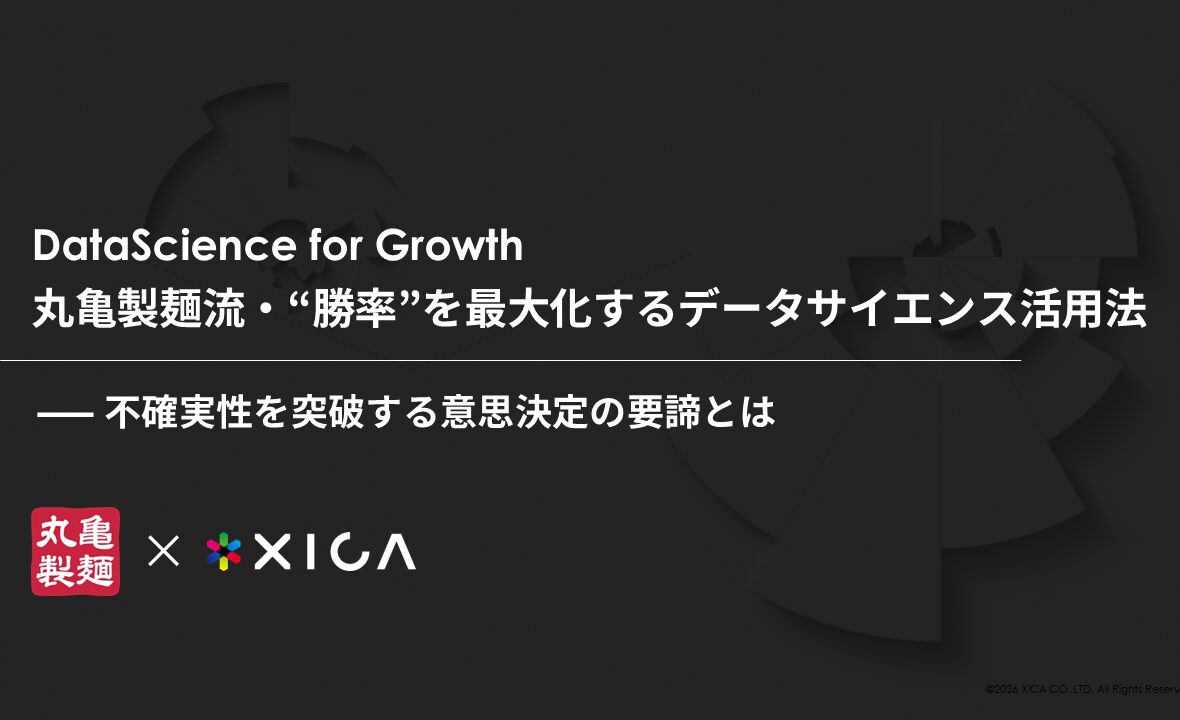
DataScience for Growth: Marugame Seimen's Method for Maximizing "Winning Probability" Through Data Science – The Key to Decision-Making That Overcomes Uncertainty [MarkeZine Day 2026 Spring Event Report]
-
 About XICA
ST Corporation's Challenge: Redefining Mature Brands Through "Data Science x AI x Human Resources" [Brand Summit Spring 2026 Event Report]