I had no clear vision of what a PM should be like, but now I'm aiming to become a rule breaker

"This is the first project I've been assigned to, and if I had to rate it myself, I'd give it a 5."
Kaoru Ookido, who currently serves as a product manager (PM) in the XICA development organization, is responsible for everything from formulating the product vision to promoting on-site development. Ookido has had a wide range of work experience, from development to the business field. How does he combine these experiences to face his work and organization? And what is his goal for the future?
I listened to Okido's theory on PM.

The first project I worked on was just five projects.
── Mr. Okido, your first experience as a PM was at the company you joined as a new graduate.
Yes. The company I joined as a new graduate was a compiler manufacturer (※1). I was 27 years old when I was first involved in product development. It was a project to create an OS operation test tool, and the development period was one and a half years.
── How do you feel looking back on that project?
If I were to rate it myself I'd give it a 5.
The project started with the requirements definition still unclear. Progress was not managed.
There were also challenges with team management, as there was no clear image of what a PM should be like.
While I was doing my job as a PM,The only thing we could rely on was the voice of our customers.The only way to move forward was to listen to their requests directly and incorporate them into the product, and that's actually why I worked as a sales engineer while developing the product.
*1: A manufacturer that develops tools for embedded systems

Changing jobs to a toC company is 100 times faster than toB
── He then moved to gloops, a company that provides social games and web services.
I changed jobs because I wanted to gain experience in toC, where knowledge is accumulated and engineering is advanced.
At that time, online games were at their peak. There were many people with new ways of thinking and well-honed skills, and the atmosphere, energy, and speed of work in the company were all completely different. It was a culture shock.
After joining the company, I worked as a game development engineer. The people around me were all specialists in the C# (C Sharp) language. Meanwhile, I changed jobs to web services, which I had no experience in. I desperately tried to catch up.
── It seems like it would be very difficult to get used to it. But is this the kind of environment that would allow you to improve the skills you were looking for?
That was the environment I was in. However, as I got used to the job and had time to think about my career, I started to feel that becoming a specialist might not be the right path for me.
In my case, rather than getting to the bottom of what's in front of me,Take a bird's-eye view of the whole picture, then structure and organize it.This time too, I wanted to see the bigger picture.

── Is that why you then moved on to become a data analyst and PMO within the company?
Yes, that's right. I was also very interested in business, so a year after joining the company, I switched to being a data analyst. My job was to analyze logs and propose improvements and strategies. A year and a half later, I shifted to work in the PMO (Product Management Office), where I was responsible for achieving goals, output, and reporting to management, which gradually required a broader perspective.
── From there, he was seconded to Nexon, where he is now in charge of more business-related duties.
My main duties at Nexon were purchasing products overseas, commercializing the business, and developing strategies for business growth.
BtoC moves at more than 100 times the speed of BtoB.
I flew to Korea three times in one month, determined whether the products would sell in the Japanese market, purchased them, considered the product liability to see how much success it would achieve if commercialized, and persuaded and closed the deal - all in a matter of a month.
The important thing is to move forward as quickly as possible.And I realized that the ability to execute was also an area I liked.
From the phase of developing skills to the phase of making an impact on society
── After five years on secondment to Nexon, you are now moving to XICA.
This is the end of my period of developing my abilities.I want to create a product that will have such an impact that it will change the industry and society as a whole.That's how I came across XICA.
Even though I was looking to change jobs and focus on products, I didn't really understand the tool called "Magellan" at first. It's a unique tool that uses mathematical knowledge to perform data-driven marketing analysis. It seems difficult, but interesting. That was my first impression.
One of the reasons I decided to join the company was because of the drawings made by the company's president, Mr. Hirao.A high-resolution vision and a clear roadmap to get thereThere was something that happened.
The other job is PM.The PM's job is to see the whole picture and move things forward. Understanding the big picture, structuring, and execution are key.I felt that this was a job where I could utilize my strengths and experience.
── Please tell us about your current responsibilities.
There are two specific things we do.
One is UX (User Experience).
"Who are the users?" is an important perspective in order for a product to be used.
This project incorporates a UX perspective into the development process so that the entire development team will share the perspective of "we're creating this because we want the user to have this kind of experience," and creates a system and organizational culture for working toward a unified goal.
The other project is structuring KGI/KPI from a UX perspective, which I am working on with Ikeda Shun from the advisory board.
As a company that makes visualization tools, it would be unconvincing if our organization did not optimize its visualization and observation of operations and feedback to the organization and product development in a data-driven way. We are considering this aspect and structuring our business from a data perspective.
"Providing suggestions from data" has been XICA's unwavering goal since its founding.What do you want to happen after providing the suggestions? Make it concrete and incorporate it into the product.That is my main job.
── So you are involved in the upstream part of PM work. How is your current job?
It's a great challenge for me.
My current job involves creating product visions and roadmaps, which is a highly abstract task that goes to the core of management and business.
When trying to answer this question, my experience on the business side and in toC comes in handy.
However, I still can't keep up with Hirao-san's enthusiasm, and the company is also changing in a good way. The scope of my work has also expanded overwhelmingly. Although I feel the difficulty level, it is a very challenging experience.
At XICA, all employees verbalize "the development of their talents."
When I joined the company 10 months ago,"Understand, change and progress, and strive every day"I wrote the words:
Understanding the structure and current situation, and taking one step at a time to move forward - this is the way of working that I value.
But, in light of my current work, it doesn't include the "goal" part (laughs). Progress is only possible if you have a vision. I think it would be a bit different if I rewrote it now.
And from now on,The step width becomes very largeI think so.

Experience in development from a UX perspective is a valuable asset
── So you're aiming to be an organization where the entire development team can discuss UX and functionality.
Engineers can be broadly divided into two categories.
We are looking for people who are interested in the technical aspects and people who are interested in the nature of the product.
The XICA development team is aiming for the latter, but not all engineers find that interesting. If you want to get to the heart of technology, you'll probably be more interested in new technology and efficiency than in what kind of service you're going to create, and there are naturally some people who want to start by discussing how to realize the requirements after defining them.
I think that people who want to do everything from creating a team are in the right phase now.Regardless of your orientation, it is worth it to have the experience of incorporating user experience into the development process as an engineer.I think so.
── It's been 10 months since you joined the company. What is the team like now?
A team where everyone can discuss directions and ideasIt's interesting to see all kinds of ideas come out of it.
In the last 10 months, the development process, how we proceeded, the language, everything has changed. It's changed so much that it feels like we're a different company. I think this sense of speed is also a characteristic of our current development team.

Aiming to be a rule breaker in the world
── Finally, please tell us your future goals.
There are three major ones.
First of all, we are launching a new product, so we need to release it properly and then make proper plans for what comes after that.
What is important for PMs isConsider future changes for usersThere will be a gap between the user experience we initially intended to deliver and the actual user experience. If we don't make the appropriate course corrections, no matter how good a product is, it will stop being used.We will develop the product into one that is well-used without losing sight of the directionThat is the goal.
the other one is,Importance of speed.
When I started working as an engineer, the world of toB was moving at 1/100th the speed of toC.
SaaS is gradually catching up with the speed of toC, but we still have to create better services and products faster than our client companies can provide them for toC.
Finally,To realize the world we want to create with our products.
I think that a product is the final form of accumulated knowledge, but there are many different ways to interpret technological innovation. It is often said that "AI will take away people's jobs."A rule breaker who breaks existing rules to create new systems and valueI think there are products that can be perceived as such.
The coronavirus has drastically changed the way Japanese companies work.
One product could completely change the way people work, think, and even the industry itself.
It would be most interesting if our product could become a rule breaker for the world.Is not it?

*The affiliation and title of the interviewee are those at the time of the interview.
Related Articles
-
 About XICA
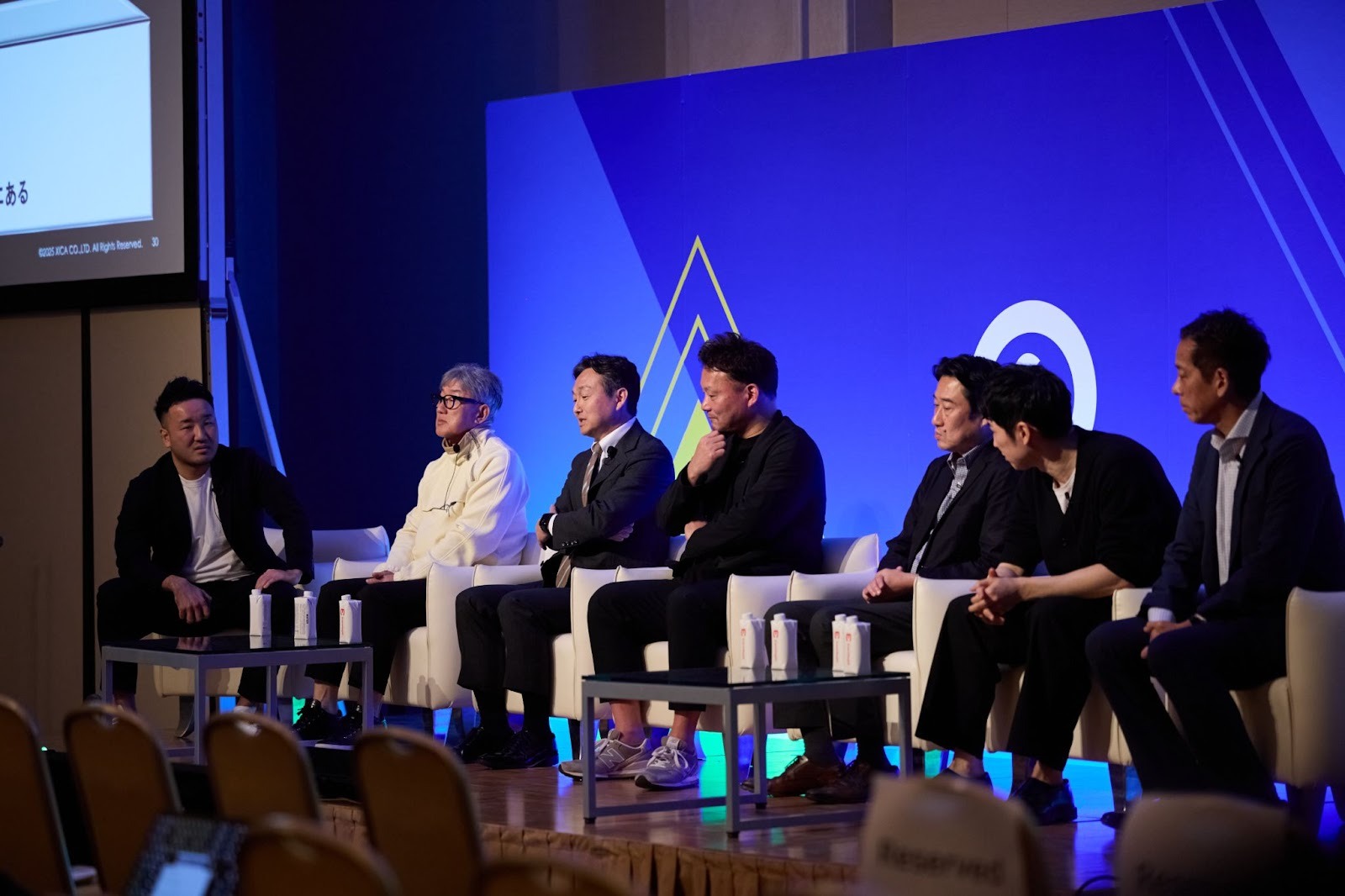
Next-Generation Management Required in the AI Era: How to Guide the Evolution of Individuals and Organizations | AWA 2025 Keynote Session Report
-
 About XICA
DataScience for Growth: Marugame Seimen's Method for Maximizing "Winning Probability" Through Data Science – The Key to Decision-Making That Overcomes Uncertainty [MarkeZine Day 2026 Spring Event Report]
-
 About XICA
ST Corporation's Challenge: Redefining Mature Brands Through "Data Science x AI x Human Resources" [Brand Summit Spring 2026 Event Report]