

Event Report: Data Science Breaks Through Constraints
--JT takes on the challenge of growing market share in a constrained market
XICA MARKETING SCIENCE LAB (hereinafter referred to as MS Lab) is a community that aims to explore optimal decision-making in marketing. A free event exclusively for members was held at the Tokyo venue on Wednesday, July 2025, 7.
The event was divided into two parts: a "seminar" where cutting-edge information and success stories on data-driven marketing were shared, and a "lab" where practical knowledge was generated through two-way communication between the seminar speakers and participants. This article reports on some of the content of the seminar.

Speakers/panelist:
*Titles are as of the time of the event.
Takuya Harada
Deputy Director, Japan Market Intelligence Department, Japan Tobacco Inc.
After graduating from the School of Political Science and Economics at Waseda University, he joined JT. He started his career as a sales representative and moved to the marketing department in 2013. Since then, he has consistently been involved in the marketing field of the tobacco business. He was in charge of industry trends and competitive analysis at the global headquarters in Switzerland, and after returning to Japan, he was in charge of customer research and market analysis in the Japanese market, and was the brand manager of the heated tobacco product Ploom. In 2023, he was in his current position, where he is engaged in exploring customer insights in the Japanese market.
Moderator
Yoshiaki Hirao
President and CEO of XICA Corporation
A graduate of Keio University, Faculty of Policy Management. Yoshiaki witnessed the banruptcy of his father's company, and this drove him to discover the potential of management support through statistical analysis in university. He founded XICA Co., Ltd. in February 2012. Based on his background in statistics and economics, he has provided extensive marketing consulting services to a number of major clients, and he has served as a product owner in the development of various products at XICA.
table of contents
Why JT continues to grow despite its constraints
Japan Tobacco Inc. (JT) is the world's third largest tobacco company in terms of sales volume. Although it has a strong share of major global markets, the environment surrounding the industry is by no means easy. In addition to the shrinking domestic market and stricter regulations, marketing activities are inherently subject to strict restrictions imposed by laws and regulations.
Tobacco products are classified into two categories: combustible tobacco products (CPTs) and reduced-risk products (RRPs). RRPs refer to products that potentially reduce the health risks associated with smoking, such as heated tobacco products. While the combustible tobacco market has been shrinking due to growing health consciousness and tax reforms, the RRP market has been expanding rapidly in recent years. JT's flagship brand, Ploom, is an RRP product and has steadily expanded its sales share since its launch. However, it is in a position to chase ahead of its competitors. In response, JT announced a plan to invest approximately 2 billion yen globally over three years starting in 2025 in the RRP field. In May 3, JT launched a new product in the RRP series, Ploom AURA, and dedicated tobacco sticks, EVO, launching a series of bold and challenging strategies.
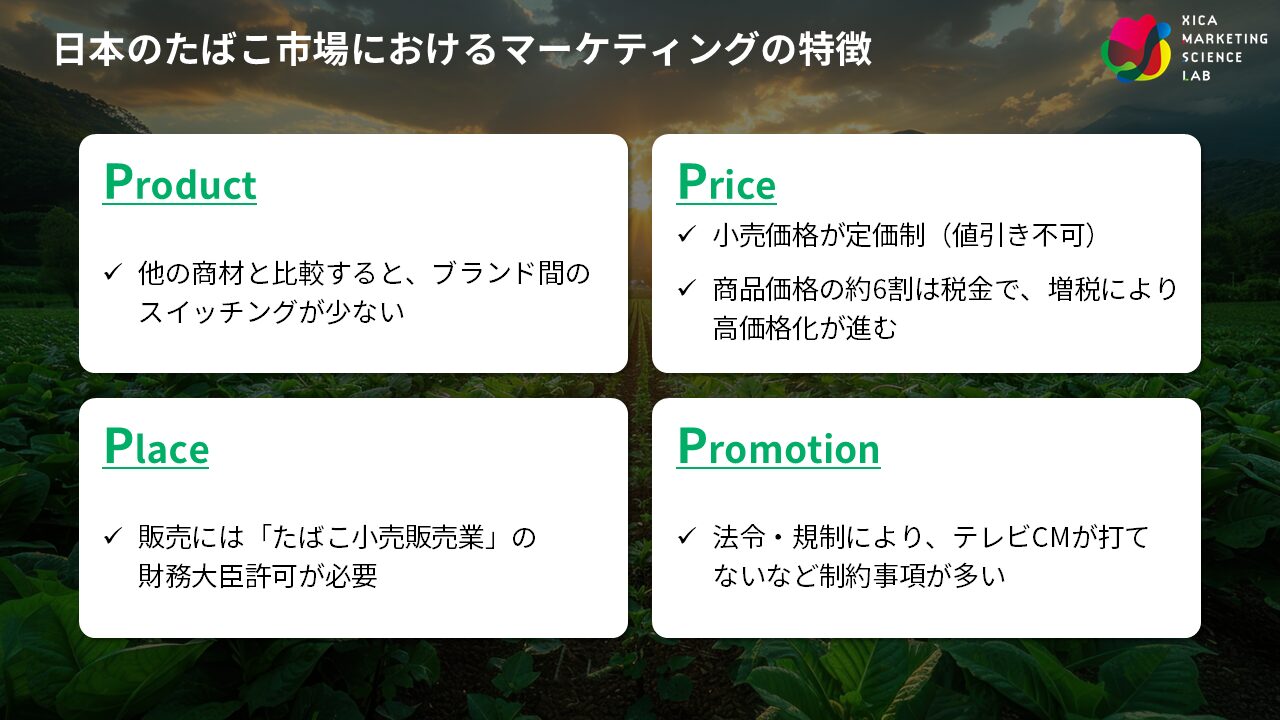
However, by its very nature, marketing activities for tobacco products in Japan are subject to many constraints, with some restrictions being placed on all four Ps of marketing (Product, Price, Place, and Promotion).
Despite these various constraints, JT has steadily strengthened the market presence of its "Ploom" series. Behind this growth lies meticulous analysis and practice to improve the precision of its marketing. At this event, we invited Takuya Harada from JT's Japan Market Intelligence Department to talk about his approach to analysis and how to translate analysis into action, using the example of the "Ploom" series.
JT's marketing strategy focuses on the "Ploom" series
JT offers a wide range of options to meet the diversifying needs of consumers as the RRP market grows. The company is currently focusing on the Ploom series, which is classified as a heated tobacco product (HTS, or Heated Tobacco Stick). Ploom uses a dedicated device to heat tobacco leaves, allowing consumers to inhale the resulting vapor, enjoying the flavor and aroma of tobacco without using fire. As of May 2025, the product is available in 5 markets. JT is currently focusing on scaling the Ploom series and allocating its marketing budget to the series, with the aim of quickly becoming the second largest player in the HTS segment in Japan, the core market for heated tobacco products. Its strategy is as follows:
First, in order to strengthen touchpoints, the company is working to increase exposure outside of stores (festivals, video streaming services, etc.) and strengthen the capabilities of its owned channels (digital marketing, one-to-one, etc.).
On top of that, they are working to gain recognition, in other words "quality recognition," to transform the brand from one that "people know the name of/have heard of" to one that "they consider purchasing." At the same time, they are working to improve customer loyalty by establishing a solid brand image. Furthermore, they aim to maximize exposure centered on their new device, "Ploom Aura," and accelerate market share growth.

Towards customer loyalty through high-quality recognition
As mentioned above, JT faced two challenges in gaining high-quality recognition and aiming to increase market share:
-High-quality awareness building is not being done sufficiently.
As a result of past marketing measures, we have been able to achieve a certain level of market share growth and quantitative recognition, but we have not been able to create sufficient high-quality recognition to steadily increase our market share.
・Measures are not being reviewed sufficiently
Although reviews were conducted from the perspective of sales and purchasing customer attributes, the long-term impact on the brand was not visualized, and short-term sales improvement measures were often prioritized.
So for the former,CMM (Consumer Mix Modeling)and for the latterMMM (Marketing Mix Modeling)Analysis was conducted using.

CMM reveals drivers of customer loyalty
CMM clarifies the factors that drive customer loyalty. The analytical model […]
Regarding the analysis content,Download from belowPlease take a look.
What is "data science that breaks through constraints"?
After looking back on the efforts made so far, when asked again about "data science that breaks through constraints," Harada said the following:
Harada: "The premise is that in order for the entire marketing organization to make decisions with confidence, apart from personal thoughts and strong beliefs,It is necessary to show the way based on reproducible and measurable evidenceAnd I think that's what data science is for."
Harada believes that the biggest challenge in data science is "acquiring data." Because of various constraints, JT strives to narrow its focus to channels with high measurement potential and acquire precise data. By carefully analyzing data from such limited areas, it is possible to discover insights that can be applied to other touchpoints.
Harada: "Companies that are struggling with the issue of 'not being able to collect data' should never give up. I think one way to start is to identify touchpoints and measures that currently have a high probability of producing measurable data and thoroughly analyze them. By making data-driven decisions based on the data obtained and continually implementing the PDCA cycle, we should be able to have some positive impact on marketing as a whole. Our company still has room for improvement, so we will continue to work on this."
To sum up the event, Hirao listed three elements as "keys to breaking through ties," concluding as follows:
Hirao: First of all,Utilizing data science to maximize marketing accuracy" And to do that, "Develop your hypothesis skills" It is essential to have the ability to hypothesize.Increase the number of trial and error attempts (increase speed)"By repeating this cycle, we can ultimately break free from constraints and produce results."

Download the analytics introduction article
Recommended articles for those who read this event report
[Event Report]
Learning from Kewpie: Data-driven organizational collaboration and overall marketing optimization

[Event Report]
Optimizing communication by clarifying the structure of consumer awareness and business results